Not to Be Confused with a Toga Party or Samuel Beckett’s Play
FOUR-MINUTE READ
Before we roll out the mat, and get ready to do some downward dogs, lately, we here at Give A Paw Canine Wellness have been “chewing on” how im-paws-ible it would be for a standing or sitting upward dog not to enjoy a Greek-themed costume party with plenty of yummy feta-and-filo-based food falling on the floor or crumbled across tables at nose level?
Just keep away from the punch!
Opa!
And what dog hasn’t “jumped” at the opportunity to sit in a theater eating pup-corn, while taking in Samuel Beckett’s Waiting for Godot, the absurdist tragicomedy known for its minimalist setting and philosophical scrutiny of the human condition, featuring two tramps, Vladimir and Estragon, who wait interminably on an isolated road for a furtive figure named Godot, who—spoiler alert—never arrives?
Okay, perhaps most canines would prefer a comfy nap . . . say, twelve hours long.
Well then, if it isn’t a “wild and crazy” college party, or a chef-d’oeuvre of 20th-century theater (a bark-out to the French Poodles and Bulldogs who encouraged us to integrate this bit of lexicon snootiness: it means “chief work”), what exactly is Doga?
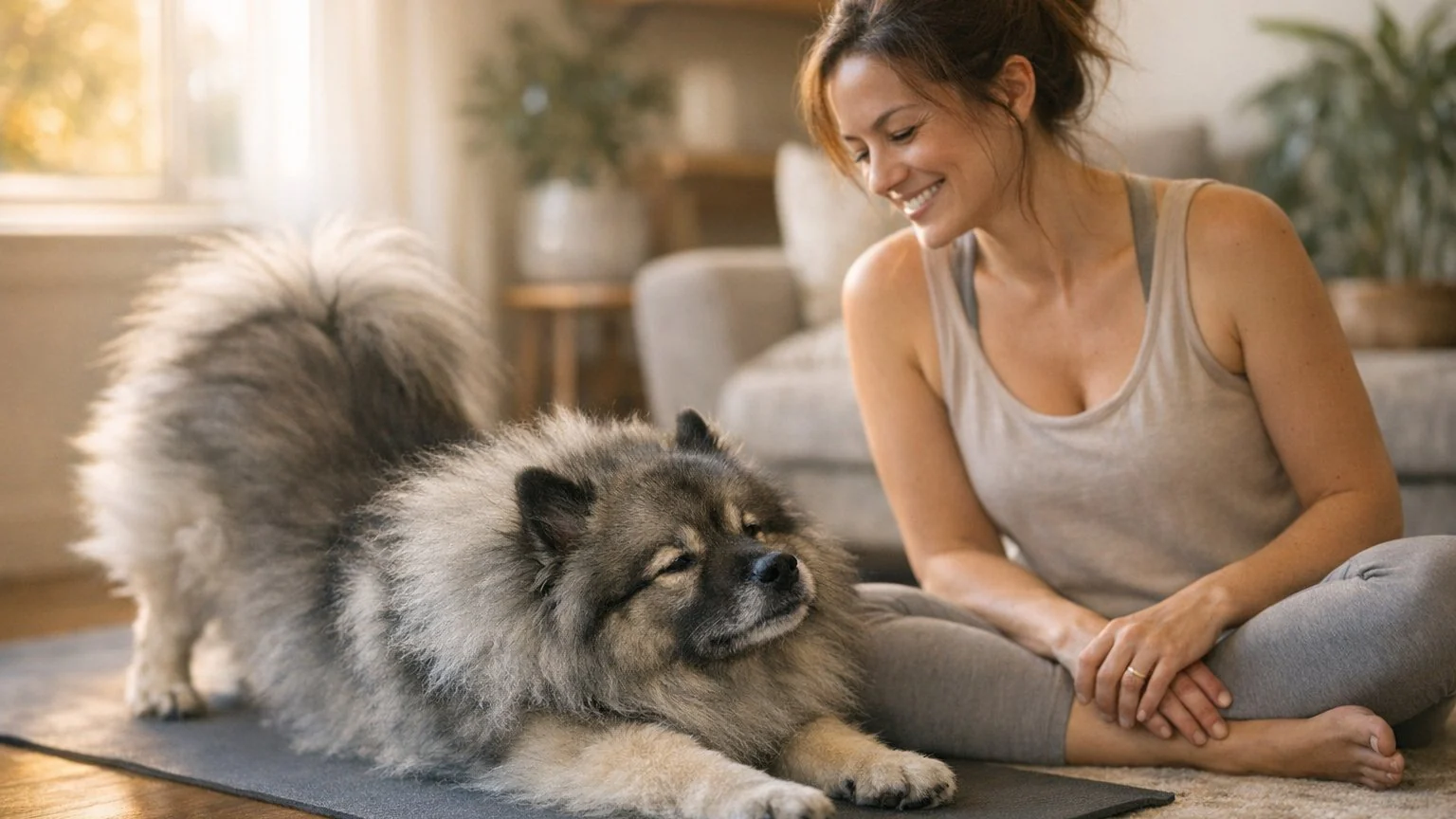
Short for “Dog Yoga,” Doga is a practice where dogs join their humans during yoga routines. The dog might rest beside the mat, or be gently stretched, or sometimes they simply observe while absorbing the vibes and attention. For many people, the allure is the shared calm and the bonding time that comes from chillaxing together.
What does the dog think or feel about all this? Can we really know? Observation of “loose” body language, relaxed facial expressions, and a willingness to stay nearby without being restrained, combined with just knowing one’s dog, can demonstrate their appreciation of the serene environment and physical closeness. When considered thoughtfully, Doga can be less about meeting a dog’s innate need to romp and roll, and more about the canine ethology and 20,000 years of connection we discussed in our inaugural blog: I Gotta Hand It To You. Sitting on the floor together, practicing gentle breathing, and offering slow, reassuring touch can strengthen your bond without asking your dog to perform unfamiliar or possibly uncomfortable movements.
On the other paw, Doga may not be for your four-legged pal; dogs do not seek stillness for its own sake. Some never stay still! They might feel bewildered by the strange pretzel-like shapes their people are making, or become overstimulated by other dogs, or become inhibited by the even more perplexing brain teasers: deep breathing, chanting, ear-piercing new age music, stinky candles, and chimes. Signs of stress can include yawning, lip licking, turning away, or trying to leave the space. Paying attention to these cues is far more significant than both of you trying to hold the impeccable Cobra or Locust pose. If your dog seems blase toward Doga, that is perfectly okay! Engagement that challenges their minds and bodies in ways that feel spontaneous and fulfilling is what makes a dog, a dog . . ..
Say, for example, fetching a ball covered in mud and slime, drinking form the toilet when the water bowl is empty, or destroying mom’s favorite pair of Christian Louboutin’s pumps.
(One could argue that true tranquility for dogs only arises after their itch for mental and physical stimulation have been scratched. “Dog enrichment” plays a powerful role, therefore, activities that foster sniffing, licking, chewing, and problem-solving help regulate a dog’s nervous system and promote relaxation. Slow feeder puzzles, scent games, and long-lasting chews offer stimulation and relaxation. Chewing helps release tension, supports dental health, and provides a sense of comfort that mimics natural behaviors. Think of these activities as another form of Doga.)
By any “stretch” of the imagination, Doga is one more pawp-tion to further deepen the bond between dogs and their people!
 Bone-Deep